In a comprehensive analysis of over 26,000 patients, fully covered self-expandable metal stents (FCSEMS) with endoscopic retrograde cholangiopancreatography (ERCP) emerged as the safest preoperative biliary drainage method, boasting fewer adverse events than plastic stents. However, they showed a higher incidence of pancreatitis. Plastic stents are linked to more complications, while internal stents are optimal for perihilar obstructions. ERCP remains the preferred technique, but percutaneous options are also viable alternatives.
GNAS droplet digital PCR effectively enhances the diagnosis of mucinous pancreatic cystic neoplasms (MPCNs) in fine-needle aspiration samples. In a cohort of 140 patients, this method achieved a 62% detection rate for MPCNs and identified 33% of inconclusive lesions as MPCNs, all with 100% specificity. Compared to traditional diagnostic methods, GNAS ddPCR markedly reduced diagnostic costs by 24%, positioning it as a valuable, cost-effective tool for clinicians.
Why knowing when not to place a drain may matter more than how to manage one.
The Bottom Line:
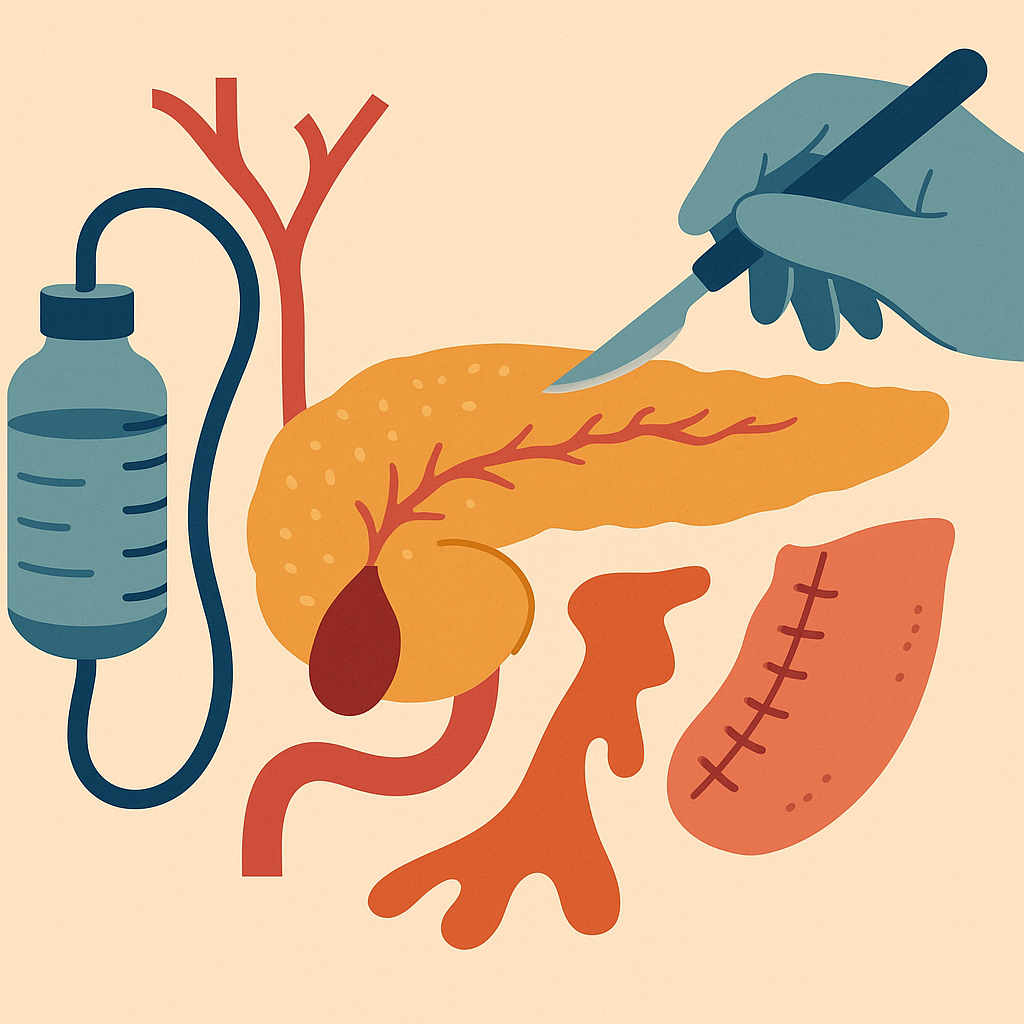
Routine prophylactic abdominal drainage after pancreatoduodenectomy (PD) is no longer universally necessary and may even increase certain risks in low-risk patients. A selective, risk-based approach—reserving drains for high-risk scenarios and removing them early when placed—yields equal or better outcomes and fewer complications.
For decades, the placement of intra-abdominal drains after PD was considered a kind of insurance policy. Something you left behind when the work was done — a whisper of presence, a plastic promise that you hadn’t just stitched and hoped. You drained because you were careful. Because you were thorough. Because textbooks said so. Because this was pancreatic surgery, and no one wanted to be the cowboy who left the belly dry and got burned. Because if a leak happened and the drain wasn’t there, the blame would be.
But over the past decade, multiple randomized trials and meta-analyses have challenged that assumption, showing:
Selective omission of drains is safe in low-risk patients, especially in high-volume centers with experienced teams (Liu et al., 2021; Lyu et al., 2020).
Yet, for patients with established high-risk features—soft gland texture, small duct diameter, or high intraoperative blood loss—drain omission may increase mortality, making selective drainage beneficial in these cases (Van Buren et al., 2014; Hou et al., 2025; Kunstman et al., 2017).
Active vs. Passive Drains: No major difference in overall complications, POPF, or length of stay; choice can be guided by surgeon preference and specific procedure, with active suction potentially lowering fistula risk after distal pancreatectomy (Zhou et al., 2023; Marchegiani et al., 2018).
Who Benefits from a No-Drain Strategy?
Ideal candidates for omitting routine drains tend to share these features:
High-volume center: experienced pancreatic teams, established fast-track pathways
Reliable postoperative monitoring: access to serial labs, imaging, and clinical follow-up
By contrast, patients with soft pancreas, small duct, high BMI, or significant blood loss remain better served by selective drain placement to guard against delayed recognition of leaks (Liu et al., 2021; Hou et al., 2025).
Optimizing Drain Management
When drains are used, timing is everything: early removal (POD 3–5) in low-risk patients with low drain amylase leads to fewer infections and shorter stays (Beane et al., 2019; Linnemann et al., 2019).
This approach turns drains from a blanket precaution into a precision tool—used only when benefit outweighs risk, and removed as soon as safety allows.
Where Do We Go from Here?
The era of “drain by default” is ending. Evidence supports a personalized drainage strategy:
Not every patient needs a drain, and routine omission can lower fistula and infection rates in low-risk cases.
Selective drainage remains crucial for those at high risk of POPF, ensuring timely intervention where it matters most.
Early removal protocols further minimize complications when drains are placed.
This isn’t just a technical shift—it’s a cultural one. Surgeons must move from automatic drain placement to nuanced decision-making, aligning intraoperative judgment with each patient’s risk profile and postoperative support.
By embracing a selective, evidence-based approach, we enrich our toolkit—ensuring that every decision, drain or no drain, is tailored to optimize outcomes and patient recovery.
Artificial intelligence now enhances surgical trial design by generating synthetic data that mirrors real-world outcomes with high fidelity. In evaluating transanal transection and single-stapled anastomosis, the AI approach yielded a balanced cohort of 1,200 patients, verifying a significantly lower anastomotic leak rate in the new technique compared to traditional methods (p<0.0001). This advancement promises improved clinical trials while ensuring patient data privacy and maintaining statistical rigor.
Hypothetical interventions targeting nutrition, anxiety, and family cohesion significantly lower frailty risk among older gastric cancer patients. A single focus on nutrition proved most effective, reducing risk by 21%. Joint interventions yielded even greater results, with all-factor combinations slashing risk by over 31%. These findings underscore the importance of tailored support systems in enhancing recovery and overall well-being in this vulnerable group, informing future intervention strategies.
Transcutaneous electrical acupoint stimulation (TEAS) significantly accelerates gastrointestinal recovery after abdominal surgery, according to a meta-analysis of 16 randomized controlled trials involving 2,300 patients. TEAS decreases time to first flatus and defecation, expedites oral intake, and reduces postoperative nausea and vomiting. It also lessens pain intensity and lowers hospital stays and costs. These findings underscore TEAS’s potential as an effective adjunct in enhanced recovery after surgery (ERAS) protocols.
Postoperative anti-PD-1 therapy significantly enhances overall survival and recurrence-free survival in hepatocellular carcinoma (HCC) patients, particularly those with vessels encapsulating tumor clusters (VETC), a marker of aggressive disease. Among 388 patients studied, those receiving the therapy showed improved outcomes compared to untreated counterparts, while VETC status emerged as a crucial prognostic biomarker. This study underscores the importance of tailoring immunotherapy based on disease aggressiveness.
Surgical site infections (SSIs) pose a critical threat in low- and middle-income countries, affecting up to 25% of surgical patients. Limited resources and rising multidrug-resistant pathogens worsen the challenge. Tailored interventions, including active surveillance, revised surgical practices, and enhanced patient education, offer promising solutions. By emphasizing infection prevention and fostering collaboration among healthcare providers and policymakers, LMICs can enhance surgical outcomes and reduce SSI prevalence, addressing a pressing need in global health.
Advanced age, inflammatory bowel disease, and higher ASA scores significantly reduce adherence to Enhanced Recovery After Surgery (ERAS) protocols in elective colorectal surgeries. Involving 656 patients, the study reveals that weakly non-adherent patients had fewer complications and shorter hospital stays compared to non-adherent peers. Specifically, older patients and those with higher ASA classifications experienced longer hospitalizations and increased postoperative complications. Targeted strategies to boost adherence among these high-risk groups could enhance surgical outcomes.
Endoscopic suturing proves a game-changer for large Zenker’s diverticula, leading to enhanced outcomes. A study of 75 patients revealed that those undergoing z-poem with endoscopic suturing faced no postoperative interventions, compared to a significant portion of patients with the clip closure option. The technical and clinical success rates were 100% and 89.5%, respectively. Notably, dysphagia scores worsened for those with diverticula over 4 cm post-surgery, highlighting the need for better approaches in this patient group.